
Why Tailored CVs Beat Generic CVs
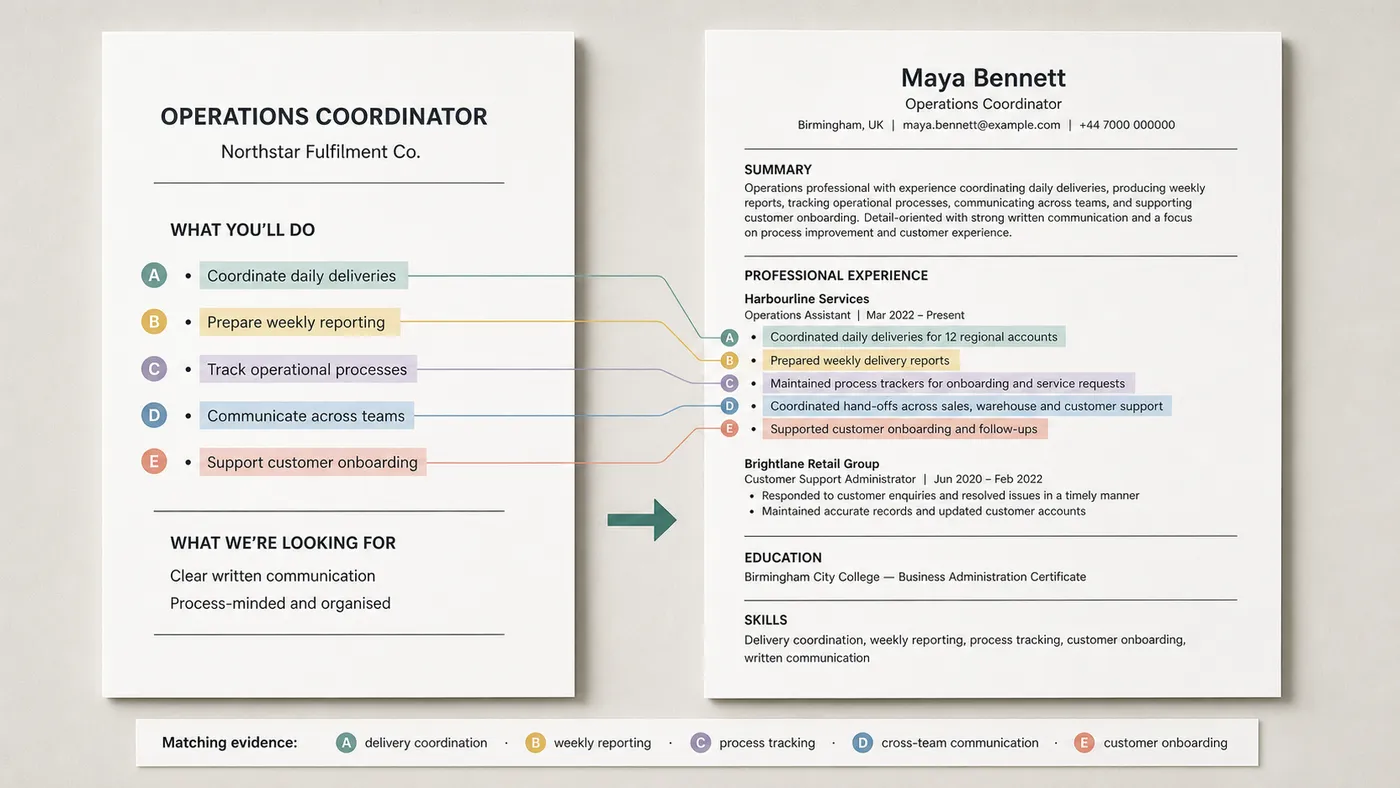
You can have the right experience and still send the wrong story.
Imagine an operations professional whose CV says she has handled onboarding, reporting and cross-team projects. She applies for an operations coordinator role. The evidence is there, but it sits under a vague profile and a bullet that reads, “Helped with onboarding, reporting and team projects.” Her CV makes the employer do the matching for her.
Then she applies for a customer success role with the same document. Again, the facts are relevant. Again, the strongest connection stays hidden.
That is the generic CV problem. The document may be accurate, polished and full of good experience, yet it gives every employer the same version of your career. A tailored CV does something more useful: it selects, orders and phrases the same truthful evidence around the role in front of you.
You are not rewriting your history. You are helping the right parts of it get seen.
Tailored vs generic CV: the practical difference
A generic CV is one finished document sent to many different vacancies with little or no change. A master CV is different: it is a private, comprehensive record of your roles, projects, qualifications, skills and results. It can be long because no employer needs to see it. A tailored CV is the focused version you create from that source of truth for one role or a closely related group of roles.
To tailor your CV to a job description, map the employer’s main requirements to your strongest genuine evidence. Then adjust your profile, choose and reorder your bullets, emphasise the right skills and use recognisable job language where it is accurate. Keep the underlying facts fixed.
That last point matters. Tailoring is not copying the advert into your CV. It is not adding every keyword. It is not stretching one small task into a skill you do not have. A tailored CV makes a truthful match clearer; it does not manufacture one.
| Keep fixed | Reconsider for the role |
|---|---|
| Employers and job titles | Profile or summary |
| Employment dates | Which achievements and projects appear |
| Qualifications and certifications | Order of experience bullets |
| Genuine responsibilities and results | Skills given the most space |
| Numbers, scope and outcomes | Accurate job-language alignment |
| Your real level of involvement | The professional direction the page communicates |
The facts in the left column protect your credibility. The choices in the right column create relevance. That combination is the whole job.
Do you need a completely new CV for every job?
No. You need one rich source of truth and focused versions built from it.
If two vacancies ask for almost the same work at the same level, the changes may be light: a sharper profile, a different first achievement and a few reordered bullets. If you move from operations into customer success, or from one sector into another with different terminology and priorities, you may need to select and frame more of the page again.
The amount of tailoring should follow the distance between the roles. It should not follow a rigid rule that says every application needs a total rebuild.
This is why a master CV is so useful. Store more evidence than one application document can carry: projects that mattered, problems you solved, people you worked with, systems you used and results you can defend. Then each tailored version becomes an editing decision rather than a memory test.
kata-ru can help you build that source of truth, starting from an existing CV or a conversation with Kira about your impact, scope and results. You get a deeper professional profile to draw from instead of trying to reconstruct your best evidence for each application.
Why a generic CV can underperform: three assessment pressures
There is no single hiring sequence used by every employer. Your CV may meet automated processing, an initial human shortlist, a closer evaluation of fit or some combination of the three. Treat them as three possible pressures, not a guaranteed funnel.
They share one mechanism: matching. Software and people can only assess the relevance your document makes visible. If you want to make your CV easier for ATS and recruiters to assess, start by making the connection between the role and your evidence explicit.
1. Automated extraction and matching
Computational recruitment systems can parse CVs and compare their content with job descriptions. That makes structure and terminology important, but not in the simplistic way most ATS folklore suggests.
A machine-readable CV is easy to extract and search. Use a clean single-column layout, standard section headings such as Summary, Experience, Education and Skills, and plain text that survives export. Avoid icons, skill bars, decorative timelines and multi-column sidebars for information the system may need to read.
Terminology matters when the employer and candidate use different names for the same thing. If the advert asks for “customer onboarding” and that is exactly what you did, use the recognised phrase instead of an obscure internal programme name. But do not paste a phrase you cannot support or repeat it unnaturally. Research on CV and job-description matching supports the matching mechanism; it does not prove that every system rejects every missing keyword.
The practical rule is simple: make true similarities legible.
2. Initial human shortlisting
An employer may shortlist applications against the job description and person specification. Some use checklists or scoring methods; others make a less formal comparison. Either way, the reader is looking for evidence that relates to the vacancy.
A generic CV often asks that reader to infer too much. “Supported team projects” could mean almost anything. “Coordinated weekly delivery reporting across sales, support and operations” gives the reader a task, cadence and scope. The second version does not become stronger because it sounds busier. It becomes stronger because the evidence-to-requirement connection is direct.
Priority also matters. If the vacancy centres on process coordination but your strongest process example appears on page two, underneath less relevant duties, your document is making the shortlist harder to complete. Reordering is not cosmetic. It changes what the reader can find first.
3. Closer human evaluation of fit
Once someone reads with more attention, isolated keywords are not enough. The CV needs to form a coherent account of why your background makes sense for this role now.
That does not mean inventing a grand career narrative. It means choosing evidence that points in the same direction. Your profile names the value you bring. Your first bullets demonstrate it. Your skills support it. Your recent projects add detail instead of pulling the reader towards a different identity.
Your CV gives the reader limited information, yet they still have to form a view of your fit for the job and organisation. That judgement depends on the person and context, so you cannot control it with a universal formula. You can control the material they see: people will make sense of the information you give them, even when that information is incomplete.
A tailored CV gives them better material to work with. It cannot guarantee progression. It can make your genuine fit easier to understand.
How to tailor your CV to a job description manually
The method below is repeatable. It is also real work. Doing it manually for every application means rereading, mapping, selecting, rewriting and checking each time. Learn the method first. Then, if repeating it for every role is the barrier, kata-ru can tailor your real experience to a specific job and company while leaving the final review and approval with you.
Step 1: Extract the role’s real requirements
Read the job description once for the overall job, then again to build a short requirements list. Do not highlight every noun. Separate what the employer appears to care about into four groups:
- Essential requirements: Experience, qualifications or capabilities presented as necessary.
- Repeated priorities: Work or skills mentioned in several parts of the advert.
- Useful extras: Relevant additions that are welcome but not central.
- Company context: Customers, sector, team structure or working environment that changes how the job is done.
The goal is a usable checklist, not a coloured job advert. Read the advert, criteria and company details, then bring forward skills you genuinely hold. If you need a starting structure, this guide to CV sections shows the standard areas to review.
For a speculative application, find a comparable advertised role and research the organisation. You still need a target. “Any role at this company” is too vague to guide good evidence choices.
Step 2: Build a requirement-to-evidence matrix
Create three columns before touching your CV:
| Requirement | Strongest truthful evidence | Where it appears now |
|---|---|---|
| Coordinate work across teams | Ran weekly hand-offs between support, sales and operations | Buried in third bullet of current role |
| Maintain accurate reporting | Owned weekly status report and resolved missing inputs | Mentioned vaguely in Skills |
| Support customer onboarding | Guided new customers through setup and follow-up | Not included |
This matrix forces a useful question: what have you actually done that demonstrates this requirement? A skill label alone is weak when you have a concrete example available.
It also exposes gaps. Mark them honestly. You do not need to look like a perfect match to present a credible application. You need to show your best evidence for the important requirements you do meet, without turning adjacent experience into something it was not.
If the middle column is hard to fill, the gap is often upstream — the evidence exists, but it was never written down anywhere you can search. Build the professional profile first, then tailor from material you have already approved.
Step 3: Choose the most relevant evidence
Your master CV may contain ten useful examples from one role. The tailored version cannot give all ten equal weight.
Choose achievements, projects and responsibilities that best demonstrate the vacancy’s priorities. Ask:
- Does this example support an essential or repeated requirement?
- Does it show what I did, not just what the team did?
- Can I describe the scope, outcome or change accurately?
- Is there another example that makes the same point more directly?
Relevance beats completeness on the application CV. The evidence you leave out is not erased from your career. It remains in the master record for a different role.
Step 4: Rewrite and reorder for clarity
Now edit the application version. Start at the top because the profile and first evidence shape the reader’s interpretation of everything below.
Update your profile so it names your relevant professional direction and strongest supported capabilities. Move the most useful bullets earlier within each role. Rewrite vague bullets to show the connection between action and requirement. Keep employers, dates, facts and outcomes unchanged.
A reliable bullet often answers three questions:
- What did you do? Use a direct action.
- Where or at what scope? Name the process, people or setting.
- What changed? Add a result only when you can stand behind it.
Do not force a number into every line. A precise description of ownership or scope is better than a metric you cannot verify.
Step 5: Align language without keyword stuffing
Job descriptions often use standard labels that your workplace did not. Translate internal language into recognised external language only when the meaning stays true.
Suppose your employer called onboarding “Launch Path”. Writing “Led Launch Path” tells an outsider little. If the work involved guiding new customers through setup, “Led customer onboarding” is clearer and accurate. Keep the internal name only if it adds useful context.
This is how to use CV keywords from a job description: as accurate labels for evidence, not decorations around it. Never add a skill because the advert repeats it. Never copy whole sentences. Never turn one exposure into claimed expertise.
Step 6: Test for both the machine and the human
First, check the document as if a system needs to extract it:
- Use one column and standard headings.
- Keep contact details and dates in plain, readable text.
- Remove icons, charts and skill bars that carry meaning.
- Export the file and confirm no text has moved, vanished or become garbled.
Then check it as if a person needs to make a decision:
- Can the top requirements be connected to evidence quickly?
- Does the profile agree with the experience below it?
- Are the most relevant bullets easy to find?
- Does every claim remain accurate under closer questioning?
An ATS-friendly CV should still be a good human CV. Clean structure helps both readers; truthful relevance carries the rest.
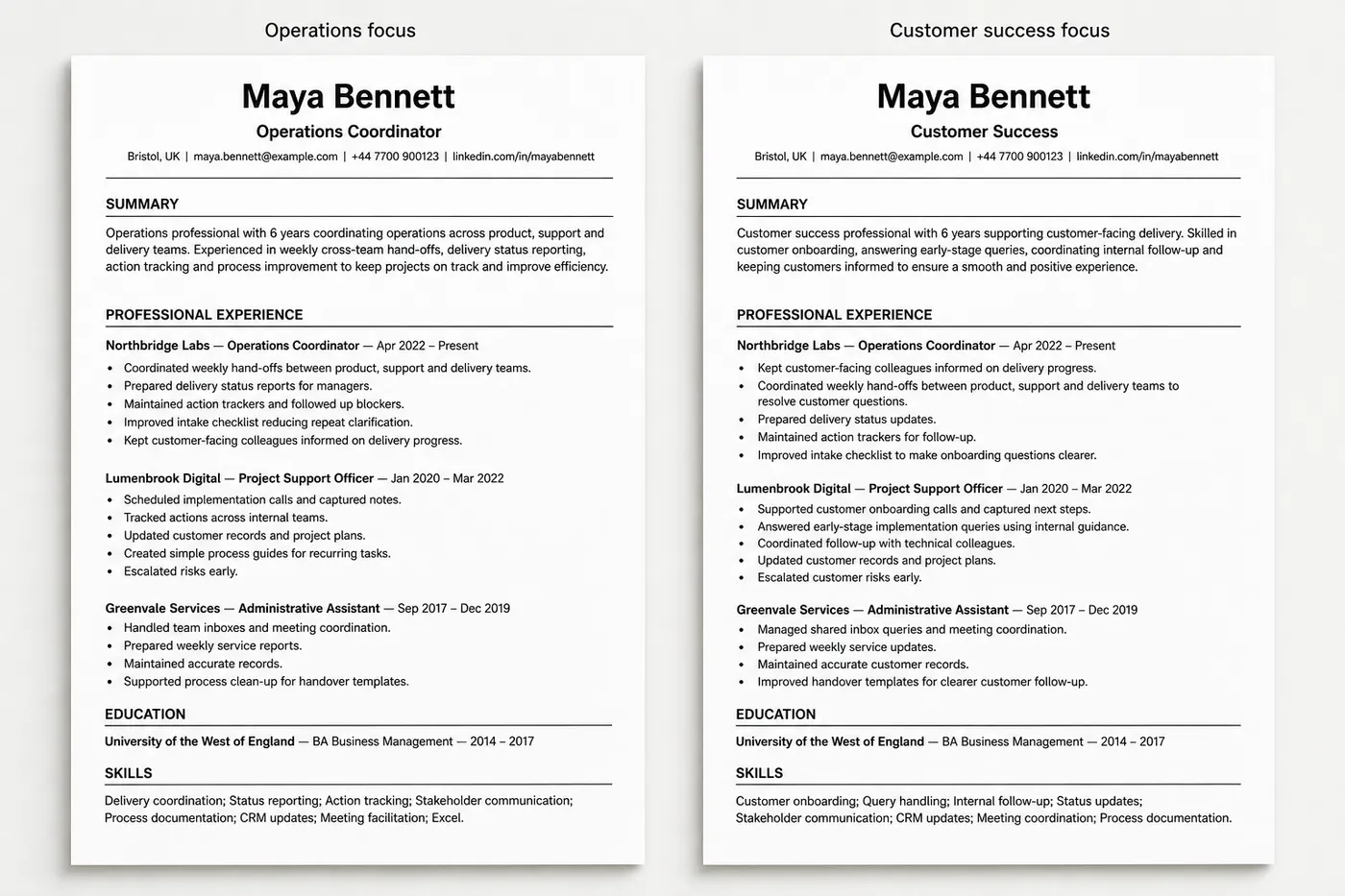
Worked example: one truthful career history, two tailored CVs
Return to our anonymous operations professional. Her source facts are straightforward:
- She coordinated weekly work across three internal teams.
- She maintained a delivery report and followed up on missing updates.
- She guided new customers through onboarding.
- She helped redesign one hand-off that reduced avoidable follow-up work.
Those facts do not change. The selection and emphasis do.
Generic version
Profile
Experienced professional with a background in operations, customer service and team projects. Hard-working, organised and a good communicator.
Experience bullets
- Helped with onboarding, reporting and team projects.
- Communicated with different stakeholders.
- Supported improvements to internal processes.
Nothing here is necessarily false. The problem is that almost every phrase is broad enough to fit almost anyone.
Tailored for an operations coordinator role
Profile
Operations professional experienced in cross-team coordination, delivery reporting and process hand-offs. Brings clear ownership of recurring workflows and a practical record of improving how work moves between teams.
Reordered bullets
- Coordinated weekly hand-offs across sales, support and operations, following actions through to completion.
- Maintained the delivery status report, gathered missing updates and gave teams a consistent view of open work.
- Helped redesign an internal hand-off to reduce avoidable follow-up work.
- Guided new customers through setup and early-stage queries.
The operations version leads with process, cadence and coordination because those are the role’s priorities.
Tailored for a customer success role
Profile
Customer-focused professional with experience guiding onboarding, coordinating internal responses and keeping customers informed as work moves across teams.
Reordered bullets
- Guided new customers through setup, answered early-stage queries and coordinated internal follow-up.
- Kept customers and internal teams informed through clear delivery reporting and action tracking.
- Coordinated hand-offs across sales, support and operations to move customer work forward.
- Helped redesign an internal hand-off to reduce avoidable follow-up work.
The customer success version puts onboarding and communication first. It does not claim a new job title, credential or result. The same career history now answers a different employer question.
When light-touch tailoring is enough—and when it is not
Not every vacancy deserves the same depth of edit. Use the role distance to decide.
Light-touch tailoring is usually enough when:
- The vacancies sit in the same role family.
- The seniority and scope are similar.
- The main requirements substantially overlap.
- Your current profile and first-page evidence already point in the right direction.
- The employer uses familiar sector language for work you have done.
You might adjust the profile, swap the order of two achievements, add one missing relevant project and check terminology.
Deeper tailoring is usually needed when:
- You are moving into a different function.
- The sector changes what good performance looks like.
- The customer or stakeholder context is different.
- The vacancy gives priority to capabilities your current CV buries.
- Your generic version tells a professional story that points elsewhere.
A career changer may need to choose evidence across several roles rather than relying on the latest job. A senior candidate may need to reduce operational detail and foreground scope, decisions and leadership. A new graduate may need to bring forward projects, placements and course work that demonstrate the target capability. Choose the evidence source that fits where you are now: projects and placements early on, transferable achievements during a change, and scope or leadership at senior level.
For speculative applications, use a comparable job description and company research to create a working target. Without that, “customising” often becomes a company-name swap rather than meaningful tailoring.
The hidden cost of doing this well for every role
The manual process is not one title change. You extract requirements, search your own history, map evidence, decide what to cut, rewrite the top third, reorder bullets, check terminology, inspect the format and proofread the result. Then the next vacancy changes the priorities and you do it again.
That repetition creates a real time-and-quality tension. When you are applying around a full-time job, caring responsibilities or the pressure of unemployment, the tempting shortcut is to keep one generic document and send it everywhere. The document moves faster. The relevance does not.
The answer is not to shame yourself for needing speed. It is to separate the work that requires your judgement from the work that can be assisted. You must own the facts, decide what feels true and approve the final story. You do not need to rebuild the supporting structure by hand every time.
How kata-ru reduces the repetitive work
Kira, kata-ru’s AI assistant, builds a deep professional profile through conversation, asking about impact, scope and results rather than storing job titles alone. You can also begin with an existing CV or use a structured editor. That profile becomes the honest source of truth behind your applications.
From there, kata-ru can create a clean standard CV and tailor your real experience to a specific job and company. You review and approve everything. It does not invent experience, auto-apply or make the decision for you. The finished CV can be exported to PDF or Word.
That is the useful division of labour: the assistant handles more of the repetitive selection and reshaping; you keep control of accuracy, judgement and voice.
Tailored CV checklist before you submit
Use this final pass for every role-specific version:
- Requirements extracted: You can name the vacancy’s essential criteria and repeated priorities.
- Evidence mapped: Each major claim points to a genuine example from your history.
- Profile focused: The opening describes value relevant to this role, not generic qualities.
- Bullets prioritised: The strongest matching evidence appears early within each section.
- Language accurate: Recognised job terms replace obscure internal labels only where the meaning is true.
- Structure clean: The CV remains single-column, standard-headed and readable after export.
- Unsupported claims removed: You have not added skills, ownership, scope or results you cannot defend.
- Facts consistent: Employers, dates, qualifications and outcomes agree across versions.
- Proofreading complete: Grammar, spacing, tense and punctuation have had a final check.
- Filename clear: The saved file identifies you and the target role without internal notes or version clutter.
A tailored resume is not a performance costume. It is a clearer answer to a specific question: why does your real experience matter here?
Keep the truth; change the emphasis
Tailoring cannot guarantee an interview. No wording trick can turn the wrong experience into the right one, and no keyword can replace evidence.
But a generic CV can hide a capable candidate behind the wrong priorities. A tailored CV brings the relevant work forward, names it clearly and gives both systems and people a fairer chance to assess the match.
Keep the truth. Change the emphasis. Make the connection visible.
Your real story, tailored for the right role. kata-ru is currently invite-only alpha; join the waitlist at kata-ru.com and keep control of every version you send.
Share

Maria Angeles Gomez Benitez
Co-founder & Product
Shapes the product and user experience at Kata-ru. Focused on making job searching less painful.
LinkedInRelated posts

Optimise LinkedIn with ChatGPT or Gemini
Use ChatGPT or Gemini to improve your LinkedIn profile, posts and messages—without losing accuracy, privacy or your own voice.

How to write your first CV after graduation
Build your first graduate CV from education, projects and limited experience, then tailor it honestly to the entry-level role you want.

Change Careers Without Starting From Zero
Keep your experience, map it to a new role, test the move before you commit, then tailor your CV honestly. A practical framework for changing careers.