
Your CV Has Two Audiences and Three Tests
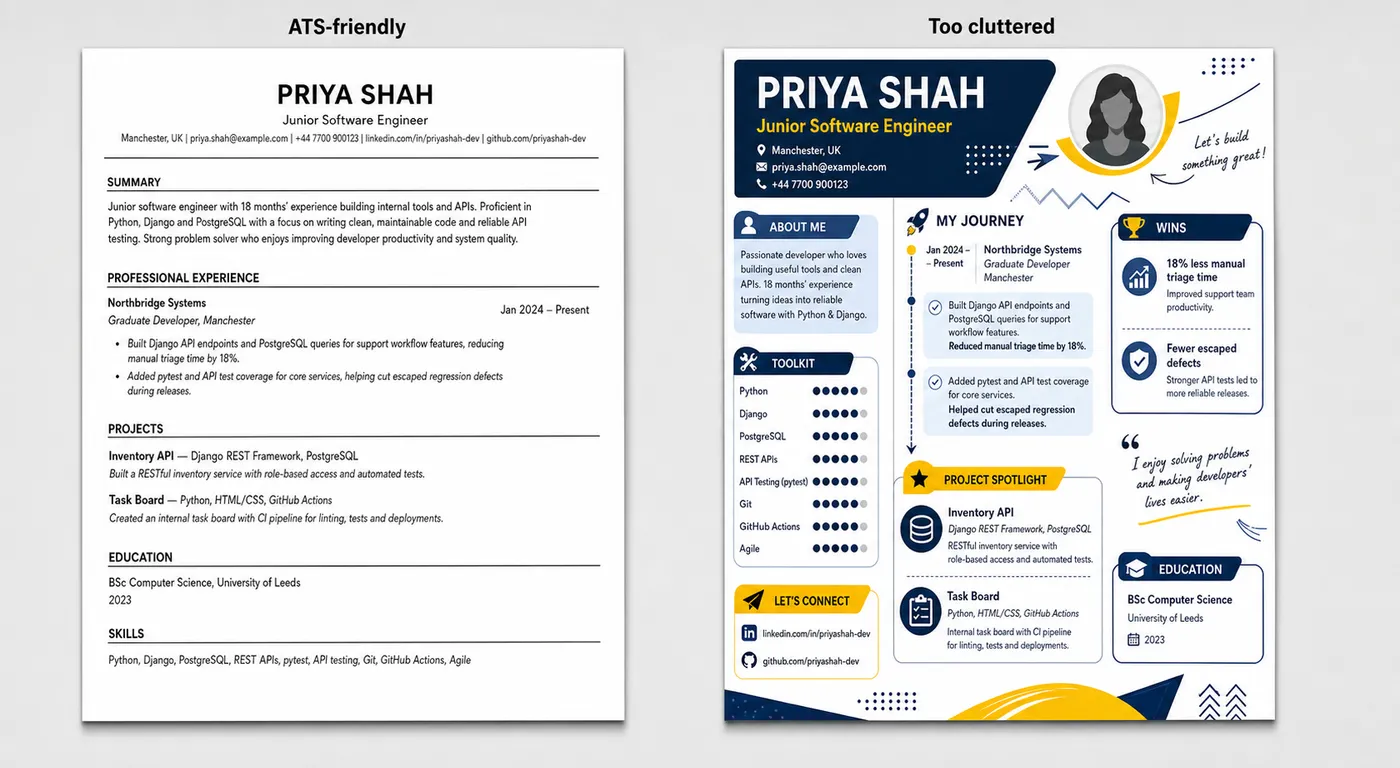
You spent hours on your CV. You picked the right font, tightened the summary, and triple-checked the dates. You hit “Submit” — and heard nothing back.
You probably assumed a recruiter rejected you. But silence does not tell you where the problem sits. Your CV may be hard for software to extract, slow for a person to understand, or weak when someone examines the claims. None of those failures proves that you are unqualified.
Your CV has two very different audiences: software and people. It also has to work under three different kinds of attention. That gives you a far more useful question than “Is my CV good?”
Which test is it failing?
Why your CV is not getting interviews: two audiences, three tests
If your CV is not getting interviews, diagnose the document under these three conditions:
- Machine readability: Can recruitment software extract the text and put names, dates, titles, skills and work history into useful fields?
- Quick human triage: Can a recruiter see the match between you and this vacancy without hunting for it?
- Careful human attention: Do your claims, dates, examples and career moves remain coherent and credible when somebody reads properly?
These are three tests you can apply to one CV, not a claim that every employer follows a fixed ATS-to-recruiter-to-hiring-manager sequence. Hiring workflows vary. Some employers use application forms, some review CVs manually, some use checklists or scoring, and some combine several methods.
The model still works because you control the same thing in every case: the document you send.
The distinction that makes the model useful
You are not writing for three imaginary personas. You are making the same truthful experience usable in three modes.
Software needs extractable information. A busy reviewer needs visible relevance. An attentive reader needs evidence that makes sense and can be defended.
That is why keyword stuffing cannot solve the problem. A perfectly parsed list of phrases is still empty if it does not point to real work. Equally, a thoughtful career story can remain invisible if it is buried in a decorative layout or a vague opening paragraph.
The goal is one story that is easy to find, easy to see and easy to trust.
Test 1: Can the software read your CV?
An applicant tracking system can parse the text in an uploaded CV and extract details such as your name, contact information, job titles, education, skills and work history. That helps turn a document into structured candidate information.
Parsing is not the same as judging your worth. It does not prove that every ATS ranks people in the same way, gives every candidate a universal score or automatically rejects a CV when extraction fails. In at least some systems, a failed parse creates manual data-entry work for the employer instead.
Still, poor extraction adds friction and can hide the facts you wanted the application to communicate. Your first job is simple: make those facts available.
A one-minute parseability check
Open the final file you intend to send and try this:
- Select all the text.
- Copy it into a plain-text editor.
- Check whether your name, headings, dates, job titles and bullet points remain in a sensible order.
- Look for missing words, broken characters or sections that have jumped around.
- Return to the vacancy and follow the employer’s requested file format.
If you cannot select the text at all, the file may be image-only. That is a warning sign: some recruitment systems cannot parse image files, and selectable text is a practical first check.
Use a single column and familiar section names. Contact, Summary, Experience, Education and Skills tell both software and people what they are looking at. Keep the typography restrained. Avoid icons carrying essential information, charts, skill bars, timelines, text placed inside images and decorative sidebars that scramble the reading order.
A clean CV is not boring. It is doing its job.
Keywords are labels for real evidence, not a password
Vacancies give you the employer’s language for the work. If the advert asks for “stock control”, while your CV says only “handled shop operations”, use the more precise term if stock control is genuinely part of your experience.
That is not gaming a system. It is naming the evidence clearly.
Start with the essential criteria in the job description and person specification. For each one, ask:
- Do I have this skill or a close transferable one?
- Where have I demonstrated it?
- Does my CV use language the employer will recognise?
- Is the proof visible, or merely implied?
Do not paste a block of keywords into the footer. Do not rename ordinary work to make it sound grander. The words should help a reader locate the proof, not pretend the proof exists.
Test 2: Can a recruiter see the fit quickly?
Employers can have many CVs to review and may decide quickly whom to interview. That makes clarity important, but it does not give you a magic number of seconds to optimise around.
Forget the countdown. Run a more useful test: can someone understand why you fit this vacancy from the top third of the page?
They should be able to locate:
- A summary aimed at this kind of role.
- Recent or highly relevant experience.
- Skills the vacancy actually requests.
- Concrete outcomes that show scope, contribution or improvement.
This does not mean cramming everything above the fold. It means controlling what the reader encounters first.
Build the top third around the vacancy
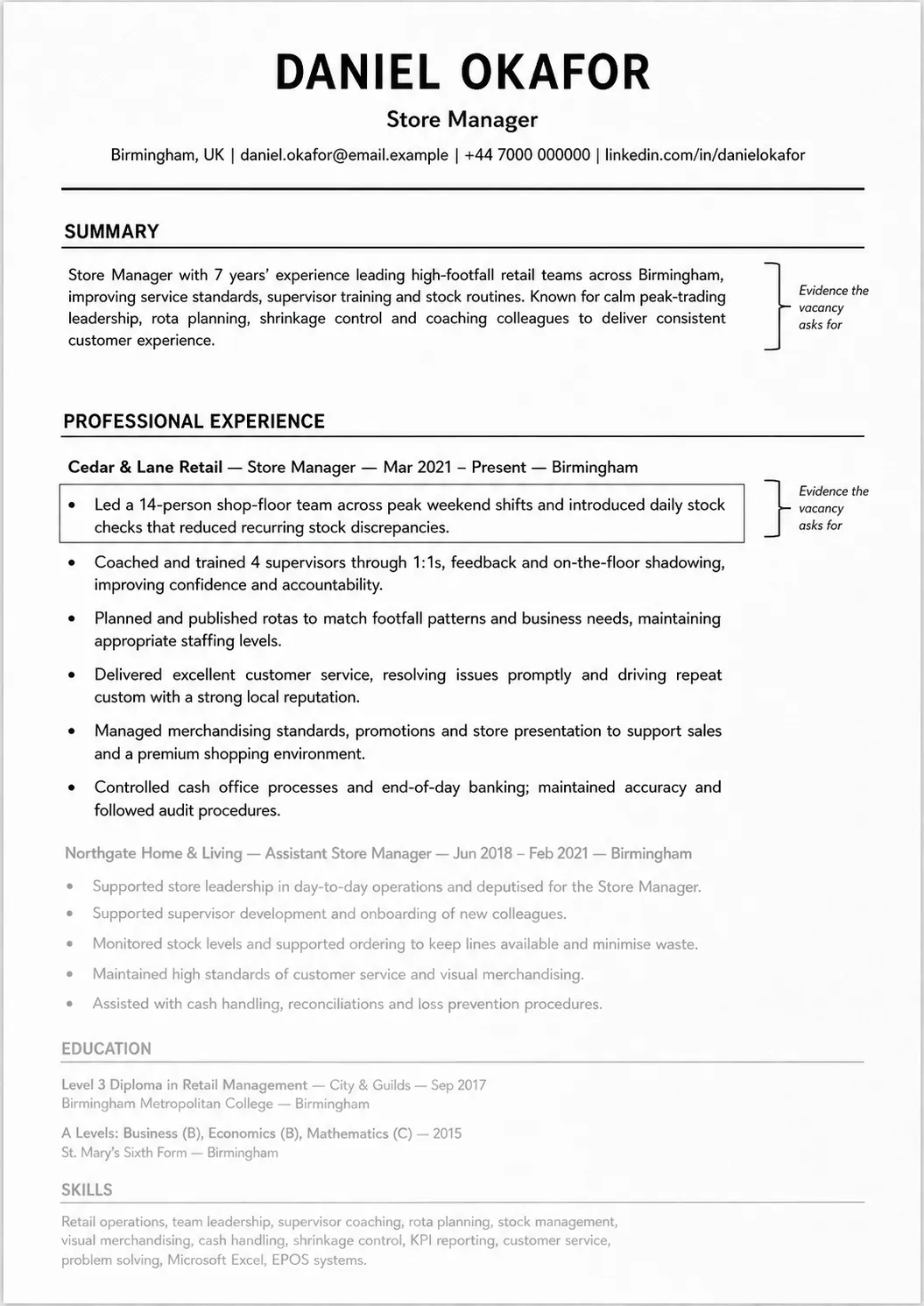
Imagine a store manager applying for a role that asks for team leadership, stock accuracy and responsibility for a busy site.
A generic bullet says:
Responsible for managing the shop floor and supporting staff.
It names a duty, but it leaves the employer to guess the scale and the result. If the facts are true, a stronger version might say:
Led a 14-person shop-floor team across peak weekend shifts and introduced daily stock checks that reduced recurring stock discrepancies.
The second version is not better because it sounds louder. It is better because it makes the relevant evidence visible: team size, operating context, action and outcome. The exact details must come from your real work. If you did not measure the reduction, do not invent a percentage. Describe the change you can defend.
Now apply the same test to your summary. “Hard-working professional seeking a new challenge” could sit on almost anyone’s CV. “Retail manager with seven years’ experience leading high-footfall stores, training supervisors and improving stock routines” gives the reviewer a reason to continue — provided each point is true and supported below.
Make progression visible without forcing a perfect career story
A coherent CV does not need to pretend that every move was planned years in advance. Careers bend. People change sectors, take caring breaks, accept survival jobs, return to study or move sideways to build a different skill.
Your task is not to manufacture a flawless trajectory. It is to help the reader understand why your experience is relevant now.
If you are moving from hospitality into customer success, do not hide the hospitality work behind vague language. Pull forward the transferable evidence: handling difficult conversations, retaining customers, training colleagues, coordinating busy shifts and solving problems under pressure. Then connect it to the target role in your summary.
Dates and job titles still need to be clear. So do transitions that might otherwise confuse the reader. A short, honest label such as “Career break — full-time caring responsibilities” can explain more than an unexplained gap surrounded by creative formatting.
Relevance is not the same as fiction. Show the bridge; do not invent it.
Test 3: Does the CV hold up when someone reads with attention?
A recruiter or hiring manager may return to your CV, compare it with selection criteria or use it to shape an interview. Treat that possibility as a credibility test, not as a guaranteed stage in every hiring process.
This is where impressive-looking language can become a liability. If a bullet makes you hesitate when you imagine being asked, “What exactly did you do?”, rewrite it now.
Check every claim for specificity and defensibility
Take each bullet and ask three questions:
- What changed? Name the output, result or problem addressed.
- What did I contribute? Separate your role from the team’s work without erasing either.
- Could I explain this? Keep only language, numbers and claims you can support in a conversation.
“Responsible for project delivery” tells the reader almost nothing. “Coordinated weekly delivery across design and engineering, kept risks visible and brought a delayed release back to the agreed plan” gives them something concrete to explore — if that is what happened.
Metrics help when they are real. They hurt when they are decoration. An honest range, team size, frequency or scope can be more credible than a dramatic invented percentage.
Then proofread. Spelling errors do more than look untidy: they can shape a recruiter’s judgement of care and credibility. Read the CV aloud, check names and technical terms, and ask another person to inspect the final exported file rather than the editable version.
Read the document as a whole
Zoom out from the bullets. Check:
- Do dates and titles agree across sections?
- Does the summary match the evidence below it?
- Are the same claims repeated without adding anything?
- Can a reader understand a sector or role change?
- Does any achievement claim more than your described responsibilities could support?
- Would you be comfortable discussing every line at interview?
A good CV does not need a cinematic arc. It needs an honest explanation of what you can do now and why this evidence belongs in this application.
That matters especially for senior candidates. A long career can produce a CV full of individually strong achievements that compete for attention. The answer is not to include every success. Select the evidence that supports this role, then make sure the selection still represents you fairly.
Why generic and unchecked AI-built CVs can miss all three tests
AI assistance is not the problem by itself. Unchecked output is.
A generated CV can fail machine readability if it arrives in a decorative template. It can fail quick triage if every sentence sounds generic. It can fail the careful read if it copies vacancy language without evidence, changes the meaning of your experience, introduces errors or gives you claims you cannot explain.
Polished is not the same as true, relevant or readable. Whether you use AI, a template, a friend or no help at all, you remain responsible for the final document.
Use AI to question, organise and sharpen the evidence you already have rather than to author or decide. Do not let it turn “helped with” into “led”, add tools you have never used or invent a number because quantified bullets look stronger.
Automation is neither neutral nor infallible
Do not treat an ATS recommendation or an AI CV score as a verdict on your value. Automated recruitment tools can carry risks of bias and exclusion, and human recruiters do not respond to algorithmic recommendations uniformly.
Your best response is not to search for a mythical machine oracle. Optimise for readable text, visible fit and defensible truth. Those choices help across different workflows without asking you to guess how one employer’s system is configured.
How to tailor your CV manually for all three tests
Here is the complete audit for one vacancy:
- Mark the essential criteria. Separate what the employer requires from what is merely desirable.
- Select true evidence. Find roles, projects, qualifications and results that demonstrate those criteria.
- Rewrite the visible sections. Aim the summary and the first relevant experience bullets at the vacancy.
- Use matching terminology naturally. Adopt the employer’s wording where it accurately describes your work.
- Run the parseability check. Inspect selectable text, reading order, headings and the requested file type.
- Read the whole CV aloud. Test the dates, transitions, claims and story you would defend in an interview.
This method is straightforward. Repeating it well is not. For every role, you have to reread the criteria, search your history, choose the right proof, rewrite the top third, check the file and challenge the whole story again. A token change to the summary will not do it. For a step-by-step walkthrough of that selection-and-emphasis work, see how to tailor one truthful CV to the role.
That manual burden is where kata-ru earns a place — after you understand the method, not instead of it.
A compact three-test checklist
Before you submit, ask:
Machine can extract it
- Is the text selectable?
- Do headings, dates, titles and bullets keep a sensible order in plain text?
- Have I used standard sections and the requested file format?
- Have I removed decorative elements that carry essential information?
Person can see the fit
- Does the top third point clearly to this kind of role?
- Are the essential skills and most relevant recent evidence easy to locate?
- Do my bullets show contribution, scope or outcome rather than duties alone?
- Have I made transferable skills visible without disguising my background?
Claims hold up
- Is every number real?
- Can I explain my contribution to every result?
- Do dates, titles, transitions and repeated claims agree?
- Have I checked spelling and the final exported document?
If one group produces several “no” answers, you have found a likely failure mode. Fix that first.
Where kata-ru earns its place
kata-ru starts with your real experience. Kira asks one natural question at a time to build a deeper professional profile — not just job titles, but impact, scope and results. From that profile, kata-ru can create a clean standard CV and tailor it to a specific role and company.
It is an assistant, not an automator. It reshapes evidence you genuinely have; it does not invent experience or apply on your behalf. You review and approve everything. The result uses the clean, single-column structure that serves both human readers and recruitment software, with PDF and Word export when you are ready.
That removes much of the repetitive work while keeping the judgement where it belongs: with you.
Your CV should make the same true story easy to find, see and trust
You do not need to game three judges. You need one honest story that survives three modes of attention.
Make it extractable for software. Make the fit visible to a busy person. Make every claim credible when someone looks closer. Then repeat that work for the actual role in front of you, not an imaginary average employer.
Your experience deserves a fair presentation. Your CV is how you give it one.
Your real story, tailored for the right role. Join the waitlist.
Share

Maria Angeles Gomez Benitez
Co-founder & Product
Shapes the product and user experience at Kata-ru. Focused on making job searching less painful.
LinkedInRelated posts

Optimise LinkedIn with ChatGPT or Gemini
Use ChatGPT or Gemini to improve your LinkedIn profile, posts and messages—without losing accuracy, privacy or your own voice.

How to write your first CV after graduation
Build your first graduate CV from education, projects and limited experience, then tailor it honestly to the entry-level role you want.

Change Careers Without Starting From Zero
Keep your experience, map it to a new role, test the move before you commit, then tailor your CV honestly. A practical framework for changing careers.