
Kata-ru is your job-search assistant, not a job-search automator
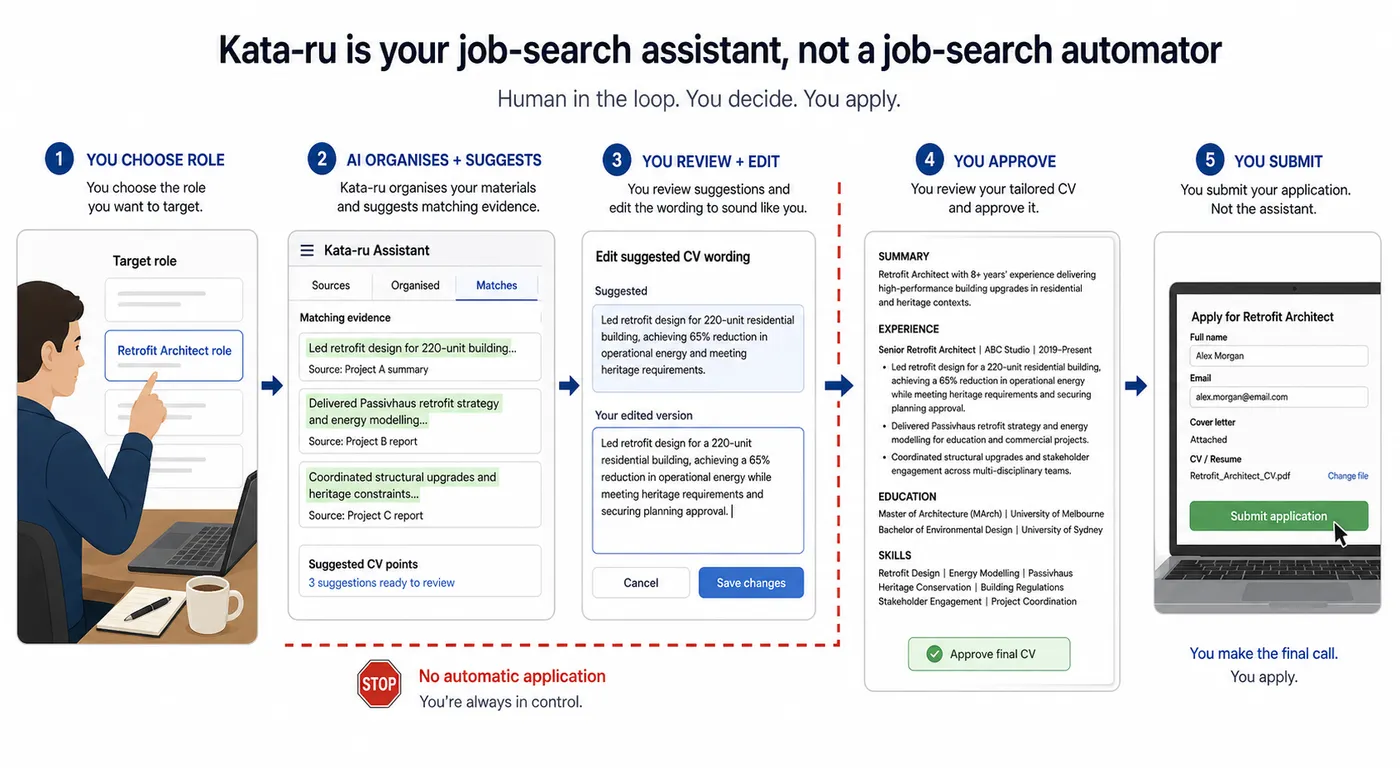
You can use AI in your job search without handing over the parts that make an application yours. Choose the role yourself. Supply the evidence yourself. Tailor selectively. Review actively. Submit yourself.
That five-part rule is the safe answer to the question “How should I use AI in my job search?” Use an assistant to organise a long professional history, extract the requirements from a job advert, compare those requirements with your real experience and suggest clearer wording. Do not ask it to choose your career direction, invent a qualification, turn every application into the same document or press Submit on your behalf.
Finding a job affects your income, time and confidence. The decision deserves your participation. AI can reduce repetitive CV tailoring, but it should support your judgement rather than quietly replace it.
Use AI as an assistant, not an automator
There is a useful difference between assistance and automation.
Assistance helps you do careful work faster. It might organise notes from several projects, identify the explicit requirements in a vacancy, map each requirement to evidence you provide or suggest a shorter bullet point. You still decide whether the role fits, whether the evidence is accurate and whether the wording sounds like you.
Automation tries to move the decision out of your hands. It may generate unsupported achievements, recommend roles as if its list were complete, produce near-identical applications or encourage you to approve a confident answer without checking it. A polished sentence is not proof that the sentence is true.
Use AI for editing-oriented help, not as the author or decision-maker. A large field experiment found that non-generative algorithmic writing assistance increased hires for new labour-market entrants by 8%. The tool offered corrections and suggestions for spelling, grammar, punctuation, word usage, tone and style. That is evidence for editing help in a particular contract-work market—not proof that fully AI-authored applications improve hiring everywhere.
The editing-assistance evidence came from an online contract-work market, so it does not establish a universal employer response. The useful lesson is not “generate more documents”. It is make the document you choose to send clearer and more relevant.
AI should not be your only source of job recommendations, either. A tool can miss niche opportunities, emerging work, current context and the human connections that lead to opportunities. Search broadly, speak to people, use professional networks and inspect the employer’s own information. Use AI to help you think through a role, not to define the whole market for you.
Start with the role, not the tool
Before you open a chatbot or CV assistant, run a short decision gate:
- Is this role genuinely relevant to the direction you want to take?
- Can you support the essential requirements with real evidence?
- Is this company and its work worth your attention?
You do not need a perfect match. You do need a credible reason to apply and enough substance to explain why you could do the work.
Read the job advert yourself first. Mark the responsibilities that matter most, the constraints you would need to understand and the parts that are merely familiar wording. Then investigate the company and the team through reliable, current sources. AI-generated recommendations can be useful prompts, but they should not be treated as a complete or neutral map of your options.
This is also where “should I use AI for job applications?” gets a practical answer. If you have not decided that the role deserves your effort, there is nothing useful to tailor yet. The tool should not turn uncertainty into a completed application just because it can.
Build a truthful source of material
Your master CV or professional profile is not a document you send everywhere unchanged. It is source material.
Keep the detail that helps you make an honest case: projects, constraints, decisions, responsibilities, scope, outcomes and context. Record what you personally did, what you supported, what you owned and what changed as a result. Include the details that sit underneath a job title—the difficult handover, the design decision, the client conversation or the trade-off you managed.
The candidate supplies the facts. AI may organise them, but it cannot fill a gap with a credential, metric, tool or leadership claim.
A simple keep / verify / reject pass helps:
- Keep wording that matches your records, scope and actual contribution.
- Verify dates, figures, ownership, software, accreditations and terminology against the source material.
- Reject anything that sounds impressive but cannot be defended in an interview.
Remove identifying details before uploading a CV to a general-purpose chatbot where possible. Check the provider’s retention and training terms, and use an employer-approved system when the context requires one. Privacy guidance is not a reason to avoid every AI tool; it is a reason to understand what information you are sharing.
This source-building step is valuable and repetitive. If you do it manually, you may spend hours turning old project notes and several CV versions into one reliable profile before you tailor a single application. kata-ru is designed to help with that foundation: Kira can build a deep professional profile through conversation or structured input, including the impact and scope behind your job titles. The profile remains grounded in what you provide. If you want the method behind that foundation, see how to build a professional profile before the CV.
Manually tailor your CV to the role—then use AI for the repetitive mapping
Tailoring is not replacing your history with keywords from an advert. It is choosing the most relevant true evidence and making it easy to find.
You can tailor your CV without losing your evidence by mapping the role’s requirements to your experience manually. For one application, that means reading the advert, selecting the strongest projects, rewriting the opening summary, reordering bullets and checking every change. Do it for ten roles and the repetition becomes the work.
AI can help with the mapping if you give it a bounded task and a closed source of facts. Try prompt patterns such as:
Extract the explicit requirements from this job advert. For each requirement, map it only to evidence in the profile below. If there is no evidence, write “no evidence” rather than guessing. Suggest concise wording, then list every proposed change for my review. Do not add qualifications, tools, metrics or responsibilities.
Or:
Compare this role with my supplied experience. Separate direct evidence, adjacent evidence and gaps. Keep my scope and ownership unchanged. Suggest which existing bullets should move higher, and explain why.
A generic prompt invites a generic answer. A bounded prompt tells the system what it may use, what it must not invent and what you need to inspect. Ask AI to map evidence, not to write a new identity.
The same principle applies when you search for “how to use AI to tailor your CV in the UK”. Use British spelling and the employer’s language only where it remains accurate. Do not stuff a CV with every phrase from a vacancy. A clean, single-column CV with standard headings such as Contact, Summary, Experience, Education, Skills, Projects and Languages remains easier for both software and people to read.
AI can also help with a cover letter, but the boundary stays the same. Give it the role, your checked source material and the points you genuinely want to explain. Ask it to organise supplied evidence around the employer’s needs, compare the letter with the advert and suggest clearer wording. Then rewrite it until the reason for applying sounds like you, not like a reusable template.
Do not ask for a letter that fills every gap with enthusiasm. If you have not worked with a tool, owned a responsibility or achieved a result, the letter cannot turn that absence into evidence. Check every example, remove inflated language and make sure the CV and cover letter tell the same story. AI may help with structure and editing; you keep the evidence, voice, review and final submission decision. kata-ru can tailor a CV to a role, but it does not write cover letters or submit applications for you.
Worked example: an architect tailoring a CV without inventing experience
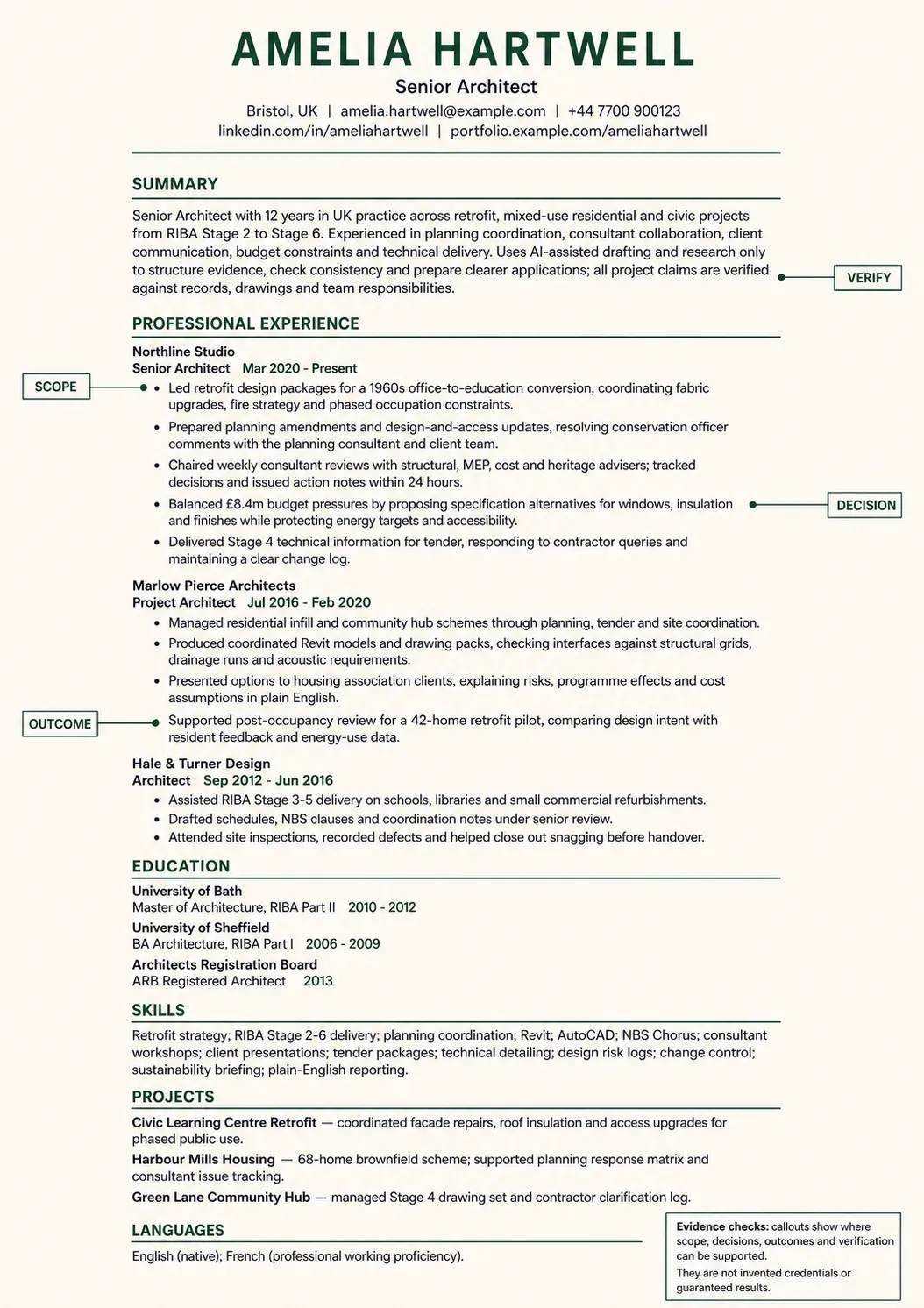
Consider Amelia, an experienced architect with a general CV covering retrofit work, planning coordination, consultant collaboration, client communication and delivery under tight constraints.
She finds a role focused on low-carbon retrofit delivery and stakeholder coordination. The advert asks for experience coordinating consultants, communicating with clients and moving projects through planning and delivery. Amelia has real evidence for those areas, but her general CV gives equal space to every project. The strongest match is buried.
Amelia’s first move is not to ask AI to “write my perfect architect CV”. She supplies a role she has already chosen and a source profile she has checked. She asks the tool to extract the explicit requirements and map them to her evidence.
The result might recommend bringing a retrofit project to the top of her experience section, moving a planning-coordination bullet higher and shortening detail about an unrelated workplace project. Those are useful changes because the emphasis changes while the evidence stays true.
Amelia can use the employer’s language when it describes work she really did. “Coordinated consultant input through planning” may be accurate if her project record supports it. “Owned procurement” is not accurate if a contractor or client held that responsibility. “Passivhaus-certified architect” is not accurate if she does not hold that accreditation. “Managed multidisciplinary delivery” may overstate “worked with consultants” unless the scope and responsibility are clear.
She also checks whether a suggested software skill is real, whether the dates are right and whether the phrase sounds like something she would say. Her revised CV is more relevant, not more fictional.
A generic CV would still be useful as the source. The role-specific version simply gives the employer the right part of Amelia’s story first. That is the same evidence-mapping problem discussed in why your CV may not be getting interviews: a CV has to be readable, relevant and defensible before the reader can understand its value.
Review the output against the source
Amelia does not approve the result because the assistant sounds certain. She checks each proposed bullet against her project record:
- Factual accuracy: Is the project, date and outcome correct?
- Scope: Did Amelia support, coordinate, advise or own the work?
- Terminology: Does the employer’s wording describe her experience, or merely resemble it?
- Voice: Would Amelia use this sentence when explaining the project to a person?
- Interview consistency: Can she describe the same work clearly under follow-up questions?
She rejects a change from “supported the project lead” to “led the project”. She rejects “managed multidisciplinary delivery” when her evidence only shows that she worked with consultants. She keeps a shorter, clearer version of a true bullet.
This is active review, not a final click. Human involvement alone does not guarantee a sound decision: people can be influenced by confident AI outputs, and cognitive bias can affect how they interpret the information. Review means checking the source, not blessing the tone.
Why mass applications and generic AI output are a poor shortcut
A tool can produce a CV for every vacancy you paste into it. That does not mean every vacancy deserves a CV.
Bulk generation creates practical risks. You may end up with near-identical documents that flatten the story that makes you distinctive. You may submit an application containing a claim you cannot explain. You may spend your limited energy checking documents for errors instead of deciding which conversations are worth having.
More documents are not automatically more relevant applications. The editing-assistance evidence came from an online contract-work market, so it does not establish a universal employer response. The practical point is simpler: volume cannot replace a credible match.
Use AI to reduce repetitive work after you have made a considered choice. Keep the role, the evidence and the final decision connected. If the output is generic, go back to the source and give the tool better boundaries—or do the wording yourself.
Keep the human in the loop at every important decision
A useful human-in-the-loop workflow has review points throughout the process:
- Role selection: You decide whether the opportunity fits your direction and circumstances.
- Data supplied: You choose what professional and personal information to share.
- Evidence mapping: You check that every requirement is matched to real experience.
- Wording: You keep, edit or reject each suggested sentence.
- Privacy: You understand where the information goes and how it may be retained.
- Final CV: You inspect dates, scope, formatting, terminology and readability.
- Submission: You personally decide whether to send it.
- Interview consistency: You can explain every line in your own spoken voice.
Written materials should sound like the person who will discuss them. If the CV describes Amelia as a procurement lead but she cannot explain that responsibility in an interview, the polished wording has created a problem.
Protect your personal information before you upload
Protect your information before you upload anything. Minimise sensitive data first. Remove unnecessary identifiers, check retention and training terms, and question any automated score or recommendation instead of treating it as a verdict. Recruitment systems can process personal information in ways candidates do not understand; some tools have made inaccurate inferences about protected characteristics, and human recruiters may rely on outputs with limited scientific validity. That is a jurisdiction-specific warning, not a claim that every employer follows the same workflow. Do not treat an automated score—whether yours or an employer’s—as a verdict on your ability.
Keep privacy practical:
- Minimise identifying data: Remove your name, email address, phone number and other unnecessary identifiers before uploading a CV to a general-purpose chatbot.
- Read the terms: Check retention, training and deletion controls before sharing detailed professional history.
- Use the right environment: Follow your employer’s policy and use an approved tool when working with confidential information.
- Question the output: Ask what evidence supports a recommendation instead of assuming the system is neutral or scientifically validated.
- Check the jurisdiction: Recruitment and privacy rules differ. General guidance is not legal advice for every employer or applicant.
You do not need to treat every AI recommendation as malicious to question it. You need enough information and control to judge whether its work belongs in your application.
Where kata-ru fits in this workflow
The manual method works. It is also repetitive when every worthwhile role requires a fresh evidence map, a new emphasis and a careful check of the same underlying professional history.
That is the friction kata-ru is built to reduce. Kira can build a deep professional profile through conversation or structured input, turn it into a clean CV and tailor that real experience to a specific job and company. The output is returned for you to edit and approve. Your real story, tailored for the right role.
kata-ru is deliberately bounded. It does not apply for jobs on your behalf. It does not invent experience, qualifications or achievements. It does not guarantee interviews or employment, and it is not meant to find a job for you. You still choose the role, inspect the result and decide whether to submit.
The product is in invite-only alpha, so the right next step is to join the waitlist if you want practical help making truthful, role-specific CV preparation easier. It is an assistant for the repetitive translation work—not an automator for your career decisions.
A final checklist before sending any AI-assisted application
Before you send an AI-assisted CV, ask yourself:
- I chose this role for a reason: I can explain why the work and organisation interest me.
- Every claim is true: The projects, dates, tools, qualifications and results match my records.
- My responsibilities are not inflated: “Supported” has not quietly become “led”.
- The wording still sounds like me: I would use these words in a real conversation.
- The CV is readable: It uses clear structure and standard headings without keyword stuffing.
- Sensitive data was handled appropriately: I know what I shared and how the tool treats it.
- I can explain every line: The document will not surprise me in an interview.
- I decided to submit: No assistant, recommendation or score made that choice for me.
If one answer is no, pause. Fix the source, edit the wording or decide that this role is not worth sending an application for. A review that changes your decision is a successful review.
The human decision stays yours
AI is useful in a job search when it removes repetition around a thoughtful application. It can help you organise real experience, map a role’s requirements and make relevant evidence easier to see. It cannot know whether a role is right for your life, whether a claim is honest in context or whether you want to put your name behind the final document.
Keep those decisions close. Let the tool handle careful repetition only when you can inspect the result.
kata-ru helps turn your real professional story into a CV tailored for the right role. It is in invite-only alpha. If that is the kind of bounded AI assistance you want, join the waitlist.
Share

Maria Angeles Gomez Benitez
Co-founder & Product
Shapes the product and user experience at Kata-ru. Focused on making job searching less painful.
LinkedInRelated posts

Optimise LinkedIn with ChatGPT or Gemini
Use ChatGPT or Gemini to improve your LinkedIn profile, posts and messages—without losing accuracy, privacy or your own voice.

How to write your first CV after graduation
Build your first graduate CV from education, projects and limited experience, then tailor it honestly to the entry-level role you want.

Change Careers Without Starting From Zero
Keep your experience, map it to a new role, test the move before you commit, then tailor your CV honestly. A practical framework for changing careers.